

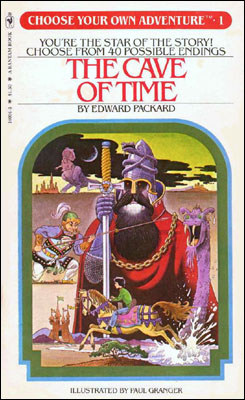
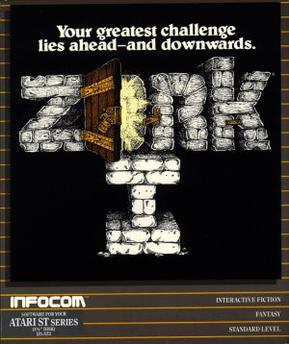
The road to digital interactive fiction (IF) started with "Choose Your Own Adventure" (CYOA) books which had the reader imagine themself in the position of the main character and "driver" of the story (Robson & Meskin, 2016). This short-lived genre of printed fiction was popular in the 1980s and 1990s and placed the reader into the shoes of the story protagonist (Wake, 2016). While the heyday of CYOA fiction has passed, this convention carried forward into the computer-based text adventure games that we still enjoy today.
IF is a type of textual work that allows the player to provide some meaningful human input into a computer interface to progress the story (Montfort, 2005). A work of IF, also referred to as a “text adventure game,” sometimes employs graphics, but the central element that makes it a game is that it requires textual input and output (Montfort, 2013; Mehta et al., 2010). Schatten et al. (2021) describes IF as possessing some or all of the following broadly defined elements: rooms connected by doors, examinable objects, non-playable characters that can be interacted with, containers, consumable items, wearable objects, etc. (p. 385).
We encourage you to explore the The Interactive Fiction Archive which does a great job of curating the history of this important game genre and literary medium.
References
Mehta, M., Corradini, A., Ontañón, S., & Henrichsen, P. J. (2010). Textual vs. graphical interaction in an interactive fiction game. Interactive Storytelling, 228–231. https://doi.org/10.1007/978-3-642-16638-9_29
Montfort, N. (2005). Twisty little passages an approach to interactive fiction. MIT Press.
Montfort, N. (2013). Riddle machines: The history and nature of interactive fiction. A Companion to Digital Literary Studies, 267–282. https://doi.org/10.1002/9781405177504.ch14
Robson, J., & Meskin, A. (2016). Video games as self-involving interactive fictions. The Journal of Aesthetics and Art Criticism, 74(2), 165–177. https://doi.org/10.1111/jaac.12269
Wake, P. (2016). Life and death in the second person: Identification, empathy, and antipathy in the adventure gamebook. Narrative, 24(2), 190–210. https://doi.org/10.1353/nar.2016.0009
Schatten, M., Đurić, B. O., & Peharda, T. (2021). An agent-based game engine layer for interactive fiction. Lecture Notes in Computer Science, 385–389. https://doi.org/10.1007/978-3-030-85739-4_38